
Published Sep 22, 202613 min read
The Control Plane of the Agent Era: Eight Rules, and What Vinkius Ships
The agent era broke every assumption the old control plane was built on. Eight rules, from on-path enforcement to a human hand on the wheel, and the Vinkius layer that ships each one, with its defaults, its numbers, and where the free plan ends.

By Renato Marinho
Founder · Vinkius
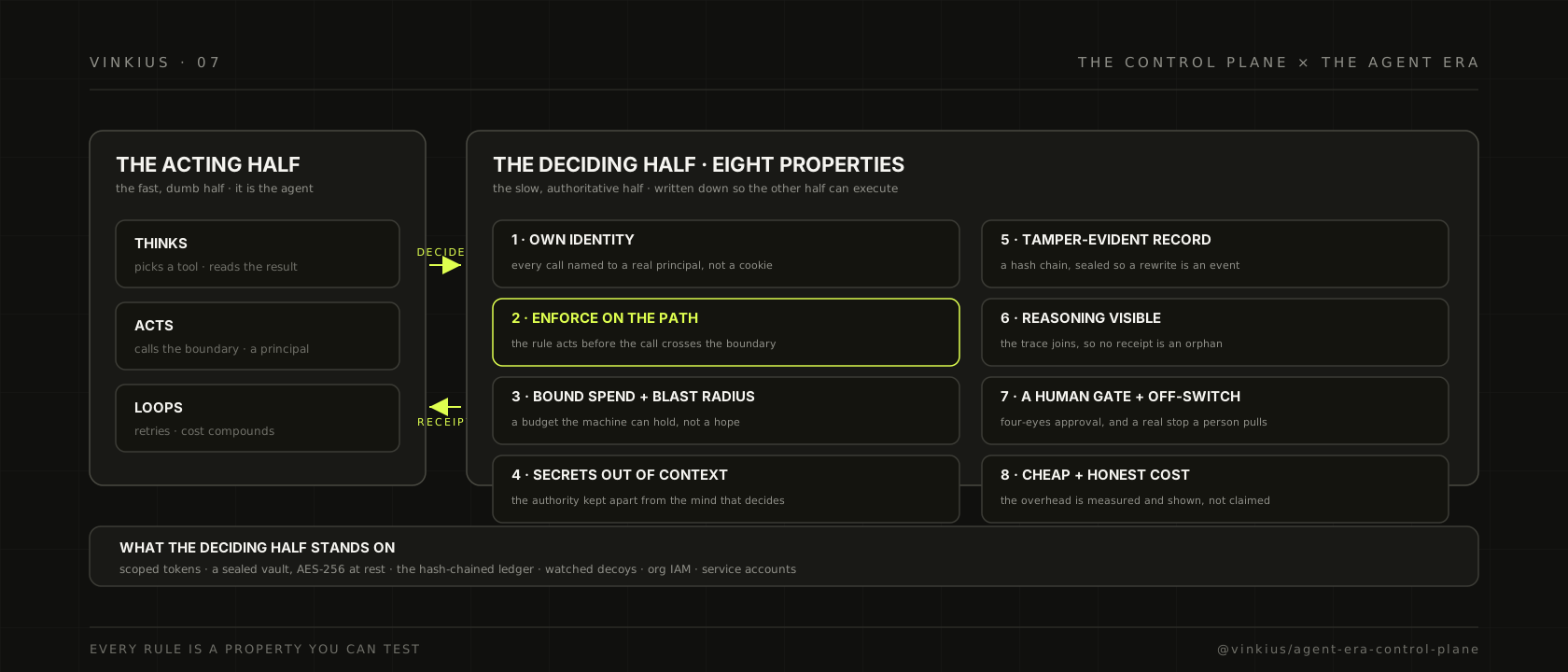
I have spent the last two years watching the word "control plane" get used in two completely different senses, and I think the conflation is quietly costing this industry. In the world of networking and Kubernetes, a control plane is the part of the system that decides. It does not carry your traffic. It says what may be built, what may be placed where, who may do what, and it writes that decision down so the data plane can execute it. The control plane is the slow, authoritative half. The data plane is the fast, dumb half.
That distinction was designed for machines that change on the timescale of minutes. A pod, a service, a route. It assumed the thing that acts is a program a human wrote, with a stable shape, a known owner, and a predictable rhythm.
None of that is true of an agent. And that is the entire point of this post.
What an agent-era control plane has to be
An agent is not a workload you deploy and forget. It is a principal that thinks. It picks a tool, calls it, reads the result, decides the next move, and loops. The shape of its behavior is shaped by reasoning, not by a fixed call graph, and a retry loop can multiply it without anyone writing a new line of code. So the assumptions the old control plane was built on, fixed shape, known owner, predictable cadence, all break at once.
What survives is the idea, not the shape. You still need an authoritative half that decides what is allowed and records the decision, and a fast half that executes. But in the agent era the authoritative half has to do more. It has to reason about a caller it cannot fully predict, enforce in a path that the model can rephrase its way around, bound a cost that compounds with every retry, and produce a record a regulator or a finance team will actually read at three in the morning.
So here is the rulebook. Eight properties, and each one is something I hold Vinkius to. Not all of them are nice to have. Some of them are load bearing, in the structural sense. If one of them is missing, the rest of the system is theater.
The eight rules
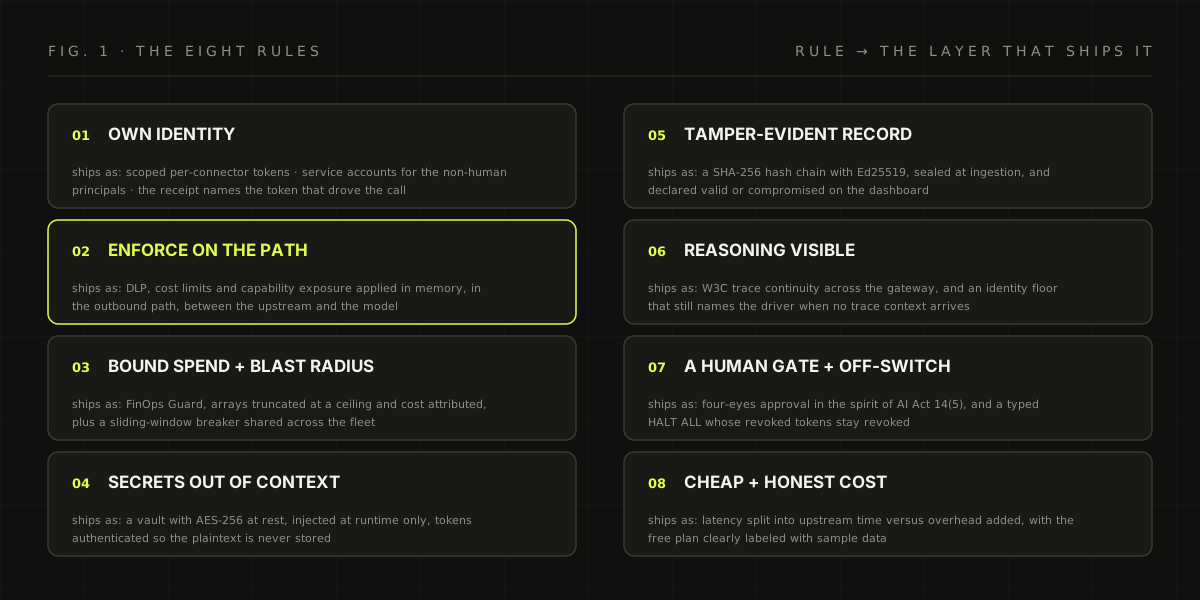
One. It must own identity. The first failure mode of most agent setups is that nobody can say who did what. The logs say a request happened; they do not say who sent it, on whose behalf, through which connector. An agent-era control plane attributes every call to a named identity, and that identity is real, not a session cookie. In Vinkius each connector has its own connection tokens, scoped to that connector only, and the token is the unit of attribution. The platform also carries service accounts for the non-human identities that run in CI and OIDC workloads, because a machine that acts in your pipeline is a principal too, and it gets named. Every receipt names the token that made the call. Identity is a column in the data, not a theory.
The scoping is what makes the column trustworthy. A token issued for the email connector cannot reach the payments connector. The tokens are HMAC authenticated and the plaintext is never stored, so there is no credential sitting in a database to steal, and the fleet itself is inventoried: who each client is, when it last called, how many requests it has made. A leaked credential is then a named, revocable, single-connector asset, not a standing pass to the whole estate, and revoke and rotate sit one click away.
Two. It must enforce on the path, not after the fact. A control plane that only reports is a dashboard, and a dashboard cannot stop what is happening right now. The enforcement has to live in the runtime, in the path of the request, before the call crosses the boundary. This is where the word "governance" does its real work. A rule that a SIEM correlates an hour later is not a rule; it is a coroner. Vinkius enforces data shielding, cost limits, and capability exposure in the outbound path, in memory, between the upstream and the model. The decision is made in flight, and the receipt records that it was made.
The shielding layer is where "masking" stops being a marketing word. It masks emails, SSNs, and card numbers in memory before the response comes back to the model. Masked, the value still does its job; the model rarely needs the raw digits, and when it does not, the digits have never entered a context window, never been logged, and never become a leak. The Mission Control strip counts the redactions it performed, DLP Protected, per period, so the layer is not just present. It is measured, and the number you see is the running count of secrets kept out.
Three. It must bound spend and blast radius. Agent cost is not shaped like any line item you have charted before. It is not per user and it is not per request. It is per thought, and it compounds with every retry a loop adds, so the control plane has to carry a budget as a first-class, machine-enforceable object. Vinkius does this in two layers. The FinOps guard truncates arrays that run past a maximum item count, fifty by default, because a response that returns ten thousand records is a token bill, not an answer; it can compress the payload before it leaves the gateway; and it attributes cost against a rate you set, three dollars per million tokens by default, then measures, in bytes and in dollars, what it saved. The circuit breaker sits in front of that: a sliding-window request budget, five thousand requests over five minutes by default, with a fifteen-minute cooldown, shared across the gateway fleet so the budget holds no matter which instance serves the call. When the budget is exceeded the breaker trips, and the trip does the thing most guardrails never do: it tells the agent, in a machine-readable refusal written for a model, that the resource is open and it should back off. A loop that cannot read that refusal gets stopped by the same trip. That is the point.
And the guard leaves a measure of its own work. The KPI strip on Mission Control shows the bytes a truncation pulled out of a response and the dollars the ceiling saved in the period, so the layer reports the bill it prevented, not the bill it charges. When a guardrail has to defend itself with a screenshot of a dashboard, you already know what its default posture is.
Four. It must keep secrets out of the model's context. This one is the one I think about most when I design. The thing that decides, the model, and the thing that proves authority, the credential, should never share a context. A model that can read your upstream password is not a problem you audit away; it is the problem. Vinkius keeps connector credentials encrypted at rest with AES-256, and the guarantee we make is that not even the platform's own operators can read them at rest. They are injected into the execution environment only at runtime, inside the isolate where the tool code runs, and the agent never sees the secret. The connection tokens themselves are authenticated in a way that the plaintext is never stored. If you want one sentence to hand a reviewer: the authority that signs a call is kept apart from the mind that makes it.
Five. It must leave a record that is tamper-evident and exportable. Most "audit trails" are append-only logs, which is to say they are as trustworthy as the person who owns the disk. An agent-era control plane has to do better, because the record is the thing a regulator, a customer, and a finance team will actually be asked to read. Vinkius seals every request hash at ingestion into a hash-chained ledger: each record carries the previous hash and its position in the sequence, and the chain is signed, SHA-256 with Ed25519. So a tamper is not a privacy issue, it is a detectable event, and the dashboard states plainly whether the chain is valid or compromised. The deployment audit exports as a PDF, and the whole structure is built for the regulator's one question, show me the full history of a connector, which arrives as a single exportable, verifiable chain, not a project.
Six. It must make the model's own line of reasoning visible. A receipt that cannot join the agent's trace is a receipt nobody can read. The control plane has to carry the caller's distributed trace context across the gateway, so that every tool span parents to the trace that started the thought. That is the work in our open framework since the 5.1.0 release, covered in the MCP Fusion 5.1.0 post on trace correlation, and it matters here because a governance record that is unrooted from the agent's own reasoning is forensically useless. And when a caller does not send a trace context, the identity floor still names who drove the call, so attribution never depends on the caller doing its part.
Seven. It must give a human a real off-switch and a real approval gate. Automation without a human-shaped stop is just a faster way to break things. The control plane has to expose two distinct human actions, and they are not the same. The first is the approval gate: a deployment that requires a second person before it goes live, which Vinkius frames on the four-eyes principle that the EU AI Act expects of high-risk systems under Article 14(5). One person does not, alone, decide that a new tool with real consequences reaches the agents. The second is the off-switch: a global emergency halt that stops every active connector in the organization, deactivates all of them, revokes every token, and terminates every open session, in one synchronous action, and the confirmation requires you to type HALT ALL, because that is the button you press when something has gone badly. After a halt you can restore, but the revoked tokens stay revoked; you reissue them on purpose. Recovery is a new trust relationship, not a replay of the old one.
Eight. It must be cheap to run and honest about its own cost. A control plane that is more expensive and slower than the thing it governs has failed, and the second half is the one most vendors dodge. The overhead of the authoritative layer has to be measured and shown, not claimed. In Vinkius the request detail breaks latency into the time the upstream API took versus the time the governance layer added, so you always know what the control plane itself cost on that call. And the platform is straight with you about what is live and what is a preview: on the free plan the governance dashboard opens with clearly labeled sample data, so you learn the shape of the control plane before you commit, while live enforcement, the circuit breaker, and the emergency halt run on paid plans. I would rather say that plainly than let a reader assume the free tier does the paid thing.
The one place the control plane itself talks to a language model is the AI Briefing, and it is a paid feature, because the briefing is a model call, and an honest control plane does not hide where its own compute goes.
The foundations the rules stand on
Some of the rules above sit on layers you will never see on a dashboard, and I am proudest of those. The marketplace carries watched decoys, planted where an attacker looking for exfiltration will find them: credentials that look like real secrets and are not. Touch one and the platform quarantines the server, revokes its tokens, cuts the open connections, and freezes its payout path, automatically, without a human deciding. Containment that does not wait for you to notice.
Underneath all of it is the organization layer. Single sign-on is enforced per organization domain, and the organization itself runs on members and teams, custom roles and the permissions they grant, service accounts for the machines that act in your pipelines, organization API keys for programmatic access, and an audit log of the security-relevant events. The control plane stands on an identity model that knows the difference between a person and a machine, and every one of the eight rules leans on that difference.
Why the rules beat the surfaces
I wrote about the twelve surfaces Vinkius ships as AI Governance, the eight that report and the four that decide. See the AI governance post for the tour. That was the inventory. This post is the standard the inventory is measured against, and the reason I keep them separate is that a vendor can show you a shelf of dashboards and call it a control plane. The surfaces are easy to fake. The rules are not, because each rule corresponds to a property you can test. Can it name the caller? Does it act before the call leaves? Does it cap a runaway loop the model can read? Does it keep the credential out of the context? Can it prove the record has not been rewritten? Can a human actually stop it? Is its own cost on the table?
I am not trying to win a naming war. "Governance", "observability", "security" will all get applied to this thing, and all of them understate it. A dashboard observes. A policy file decides, once, at deploy time, and then forgets. The control plane is the only name that carries the decision: it decides per call, and it keeps the receipt.
If you are buying, that list is the spec. If you are building, it is the checklist you should be embarrassed to have skipped. I put it in writing, in the post on how Vinkius runs every MCP server in a V8 isolate and back, because I have come to believe the control plane is the product, and the product is the rules, not the screens.
The bar I will hold the industry to
Here is where I go from engineer to, uncomfortably, the person who gets to set a bar. The agent era is going to be judged by how well its control planes did these eight things, and most of the control planes shipped today will not make the grade, because they were built for a world where the caller is a human who filed a ticket. They have a policy engine and a log. They do not have identity, in-flight enforcement, a budget the model can read, a sealed vault, a signed chain, a trace join, a human gate, or an honest overhead number. They have a dashboard and a hope.
That is not an insult. It is the gap, and the gap is where the next five years of infrastructure get decided. I wrote these rules the way I would want them written down for a team that did not build the thing: specific enough to test, and general enough to outlast this year's names. The eight properties are the contract. Everything else is marketing.
When your agent is the thing that acts, the control plane is the thing that decides. Build the deciding half first, measure it, seal its record, and give a human a real hand on the wheel. That is the standard. I hold Vinkius to it, and I would hold yours to it too.
The runtime safety controls that enforce these eight rules are detailed with source code in Enterprise AI Questions.